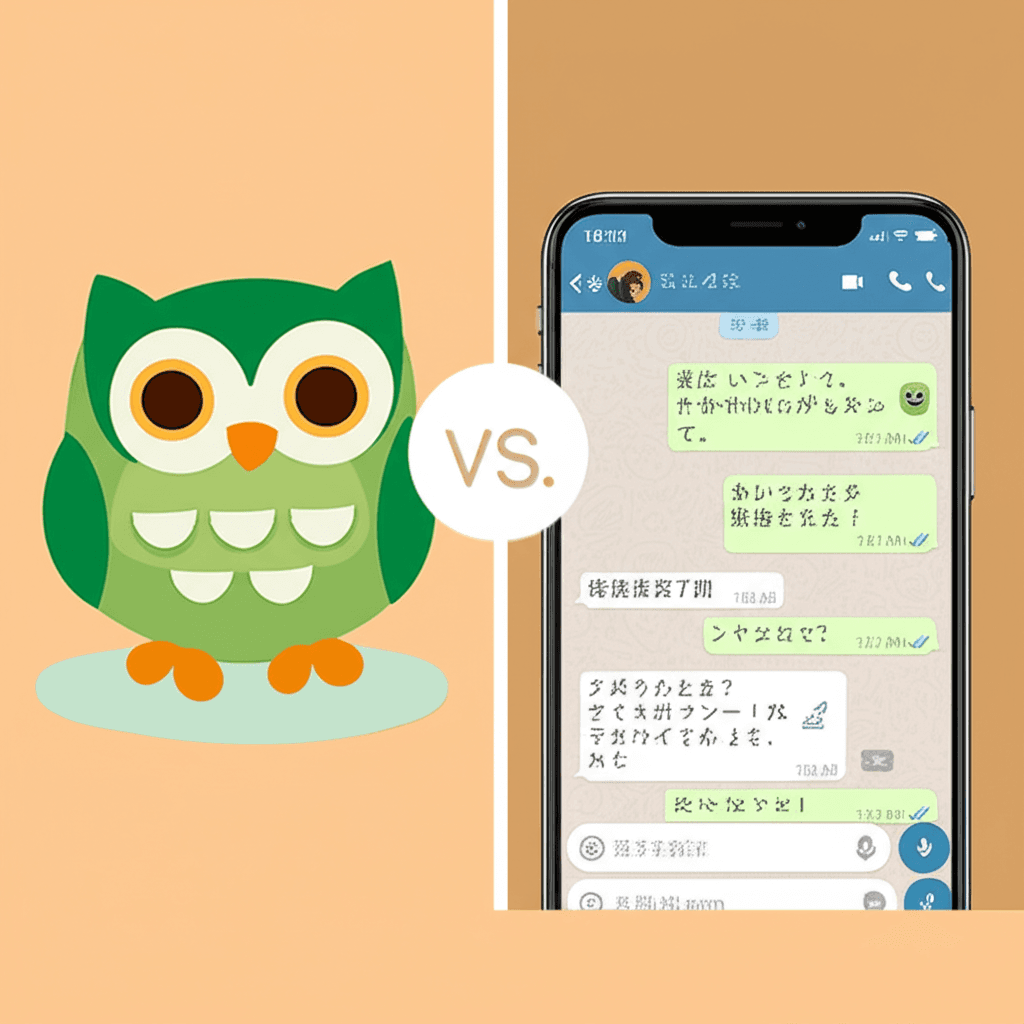
Two very different approaches
Duolingo and Japanese SenSei take fundamentally different approaches to language learning. Duolingo gamifies structured lessons across 40+ languages. Japanese SenSei provides a personal AI teacher focused exclusively on Japanese.
Neither approach is universally "better" — it depends on what you need. Let's break it down honestly.
How Duolingo teaches Japanese
Duolingo uses short, gamified lessons with translation exercises, matching, and listening. You earn XP, maintain streaks, compete in leagues, and progress through a skill tree.
What it does well:
- Habit formation through gamification
- Low-friction daily practice
- Generous free tier
- Good for absolute beginners' first exposure
Where it falls short for Japanese:
- Grammar explanations are minimal
- No real conversation practice
- Kanji coverage is limited
- Can't handle the complexity of keigo (polite speech)
- Gamification rewards participation, not mastery
How Japanese SenSei teaches
Japanese SenSei is an AI teacher that lives in your Telegram app. You choose a teacher persona (Minami or Rentaro), and they teach you through natural conversation, flashcard reviews, voice messages, and photo-based exercises.
What it does well:
- Real conversation practice from day one
- FSRS spaced repetition for long-term memory
- Teacher personality creates genuine engagement
- Structured JLPT curriculum (N5-N2)
- Proactive daily messages — doesn't wait for you to open an app
Where it falls short:
- No gamification elements (streaks, XP, leagues)
- Telegram-only (no standalone app)
- Newer platform with growing user community
Feature-by-feature comparison
| Feature | SenSei | Duolingo | |---------|--------|----------| | Conversation practice | Real AI conversations | No | | Voice practice | Yes, with feedback | Limited | | Spaced repetition | FSRS (adaptive) | Built-in (basic) | | JLPT curriculum | N5-N2 structured | No JLPT alignment | | Kanji teaching | Integrated with vocab | Minimal | | Teacher personality | Minami or Rentaro | Duo the owl (mascot only) | | Proactive engagement | Daily messages | Push notifications | | Gamification | No | Yes (XP, streaks, leagues) | | Multiple languages | Japanese only | 40+ languages | | Free tier | Yes | Yes (ad-supported) | | Paid price | $7.99/mo | $14/mo (Super) |
Who should use Duolingo?
Choose Duolingo if you:
- Want to casually try multiple languages
- Are motivated by gamification and competition
- Prefer a polished app experience
- Want a completely free option (with ads)
- Are testing whether you're interested in Japanese
Who should use Japanese SenSei?
Choose Japanese SenSei if you:
- Are committed to learning Japanese specifically
- Want actual conversation practice
- Need structured JLPT preparation
- Prefer a personal, relationship-based learning experience
- Value long-term retention over short-term XP
Can you use both?
Yes, and some learners do. Duolingo can provide quick, gamified daily practice while Japanese SenSei handles deeper learning, conversation, and spaced repetition.
However, be careful about study time fragmentation. 30 focused minutes on one platform typically beats 15 minutes on each.
The honest verdict
Duolingo is a great gateway drug for language learning. It makes starting easy and the gamification keeps you coming back. But for Japanese specifically, it stays shallow.
Japanese SenSei starts deeper. The learning curve is slightly steeper because real conversation is harder than multiple-choice quizzes. But the results compound — after three months, conversation-based learners typically outperform gamification-based learners in actual communication ability.
The best tool is the one you'll actually use consistently. Try both, see what works for your brain.
Ready to start learning?
Japanese SenSei teaches you through real conversation on Telegram — free to start, no app download needed.