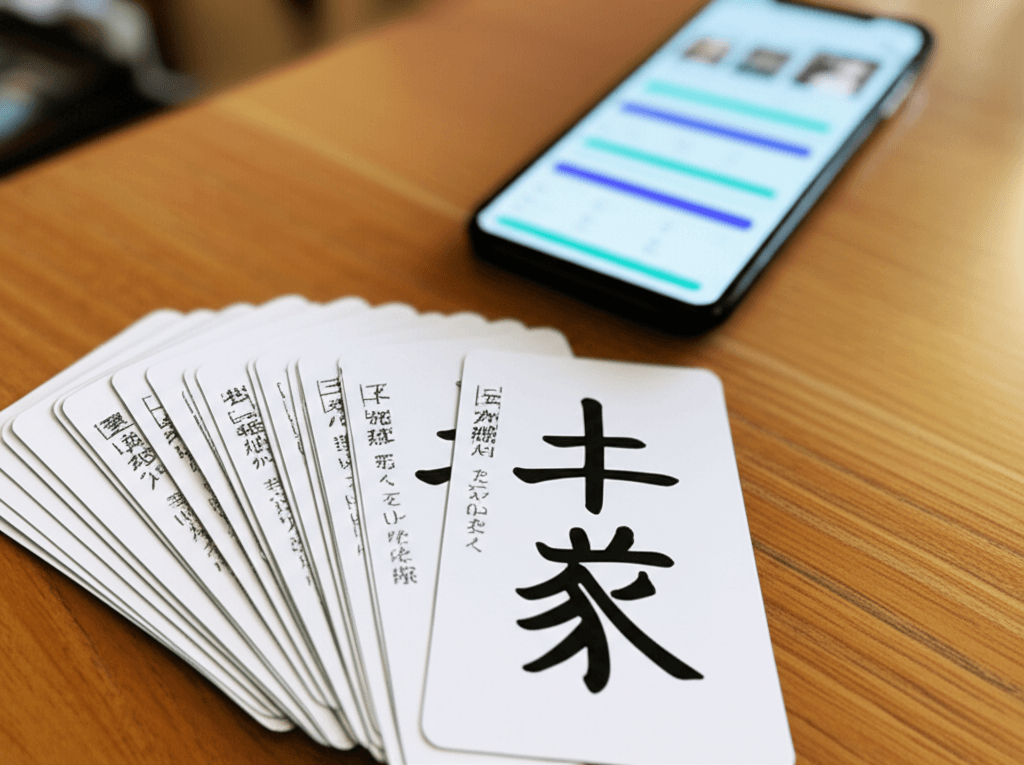
The forgetting problem
Your brain is designed to forget. Not because it's broken — because it's efficient. Most information you encounter isn't worth remembering, so your brain aggressively discards it.
The problem for language learners is that Japanese vocabulary IS worth remembering — but your brain doesn't know that. Without deliberate review, you'll forget roughly 80% of new words within a week.
What is spaced repetition?
Spaced repetition is a study technique that schedules reviews at increasing intervals. Instead of reviewing everything equally, it focuses on words you're about to forget.
The pattern looks something like this:
- Learn a new word
- Review after 1 day
- Review after 3 days
- Review after 7 days
- Review after 14 days
- Review after 30 days
- Review after 90 days
Each successful review pushes the next review further out. Each failure resets the interval. Over time, well-known words are reviewed rarely, while troublesome words are reviewed frequently.
Why it works (the science)
SRS exploits a phenomenon called the spacing effect. Information reviewed at spaced intervals is retained significantly better than information crammed in a single session.
When you review a word right before forgetting it, your brain recognises it as important and strengthens the memory trace. Review too early? Waste of time — you already know it. Review too late? You've already forgotten, so you're essentially relearning from scratch.
The sweet spot is right at the edge of forgetting. That's where the magic happens.
Note
The spacing effect has been replicated in over 300 studies across different languages and types of knowledge. It's one of the most robust findings in cognitive psychology.
FSRS: The next generation of SRS
Traditional SRS algorithms (like SM-2, used by most flashcard apps) use a simple formula that's the same for everyone. FSRS (Free Spaced Repetition Scheduler) is a modern algorithm that adapts to YOUR personal memory patterns.
How FSRS differs:
- Personalised: Learns your forgetting curve from your review history
- Adaptive difficulty: Adjusts intervals based on how easily you recall each word
- Optimised retention: Targets a specific retention rate (typically 90%) rather than using arbitrary intervals
- Fewer reviews: More efficient scheduling means less time reviewing words you already know well
Japanese SenSei uses FSRS for all vocabulary and kanji reviews. The result is fewer daily reviews with better retention — the best of both worlds.
How to use SRS effectively
Do's
Review every day. Even 5 minutes. Consistency is everything with SRS. Skipping a day means tomorrow's pile doubles.
Be honest with yourself. If you had to think hard about a word, mark it as "hard" or "again." Inflating your scores wastes time on future reviews.
Add words in small batches. 5-10 new words per day is sustainable. 50 new words leads to review burnout within a week.
Learn words in context. A flashcard with just the word and meaning is less effective than one with an example sentence.
promise / appointment
practice
Don'ts
Don't skip reviews to add new words. Reviews are more important than new cards. Clear your review queue first, always.
Don't study in huge batches. Doing 200 reviews in one sitting on Sunday is far less effective than 30 reviews daily.
Don't override the algorithm. If SRS says review tomorrow, review tomorrow. Not today, not in three days. The timing matters.
Don't use SRS as your only study method. SRS handles memorisation. You still need conversation, grammar study, and immersion for actual fluency.
SRS for different types of Japanese knowledge
Vocabulary
Best use case for SRS. Front: Japanese word. Back: reading + meaning + example sentence.
Kanji
Learn kanji through vocabulary, not in isolation. A card for 「食」should include words like 食べる, 食事, 食堂.
Grammar
SRS works for grammar too, but differently. Use sentence cards where you need to understand the grammar point to get the meaning.
Listening
Audio cards where you hear a word/sentence and recall the meaning. Great for improving listening comprehension.
The retention sweet spot
FSRS targets 90% retention by default. This means for every 10 cards reviewed, you'll remember about 9 correctly.
Why not aim for 100%? Because the review cost increases exponentially. Going from 90% to 95% retention roughly doubles your daily reviews. Going from 95% to 99% doubles them again.
At 90%, you learn the maximum amount for the time invested. The occasional forgotten word is worth the massive time savings.
Getting started with SRS
If you're new to spaced repetition, start small:
- Begin with 10 new words per day
- Do your reviews every morning (make it a non-negotiable habit)
- After two weeks, assess: too easy? Add more cards. Too overwhelming? Reduce.
- Gradually increase to your sustainable pace (most people land at 10-20 new words/day)
The compound effect of SRS is remarkable. 10 words per day means 300 words per month, 3,600 per year. That's more than enough for JLPT N3.
Consistency wins. Always.
Ready to start learning?
Japanese SenSei teaches you through real conversation on Telegram — free to start, no app download needed.